

PDFit
$20


language - javascript , html , css IT'S TWO PLAYER "TIC TAC TOE" GAME.
Tic-tac-toe, noughts and crosses, or Xs and Os is a paper-and-pencil game for two players who take turns marking the spaces in a three-by-three grid with X or O. The player who succeeds in placing three of their marks in a horizontal, vertical, or diagonal row is the winner.
Players: 2
Skills required: Strategy, tactics, observation
Other names: Noughts and Crosses; Xs and Os
Genres: Paper-and-pencil game
Gameplay - Tic-tac-toe is played on a three-by-three grid by two players, who alternately place the marks X and O in one of the nine spaces in the grid.
A player can play a perfect game of tic-tac-toe (to win or at least draw) if, each time it is their turn to play, they choose the first available move from the following list, as used in Newell and Simon's 1972 tic-tac-toe program.
Win: If the player has two in a row, they can place a third to get three in a row.
Block: If the opponent has two in a row, the player must play the third themselves to block the opponent.
Fork: Cause a scenario where the player has two ways to win (two non-blocked lines of 2).
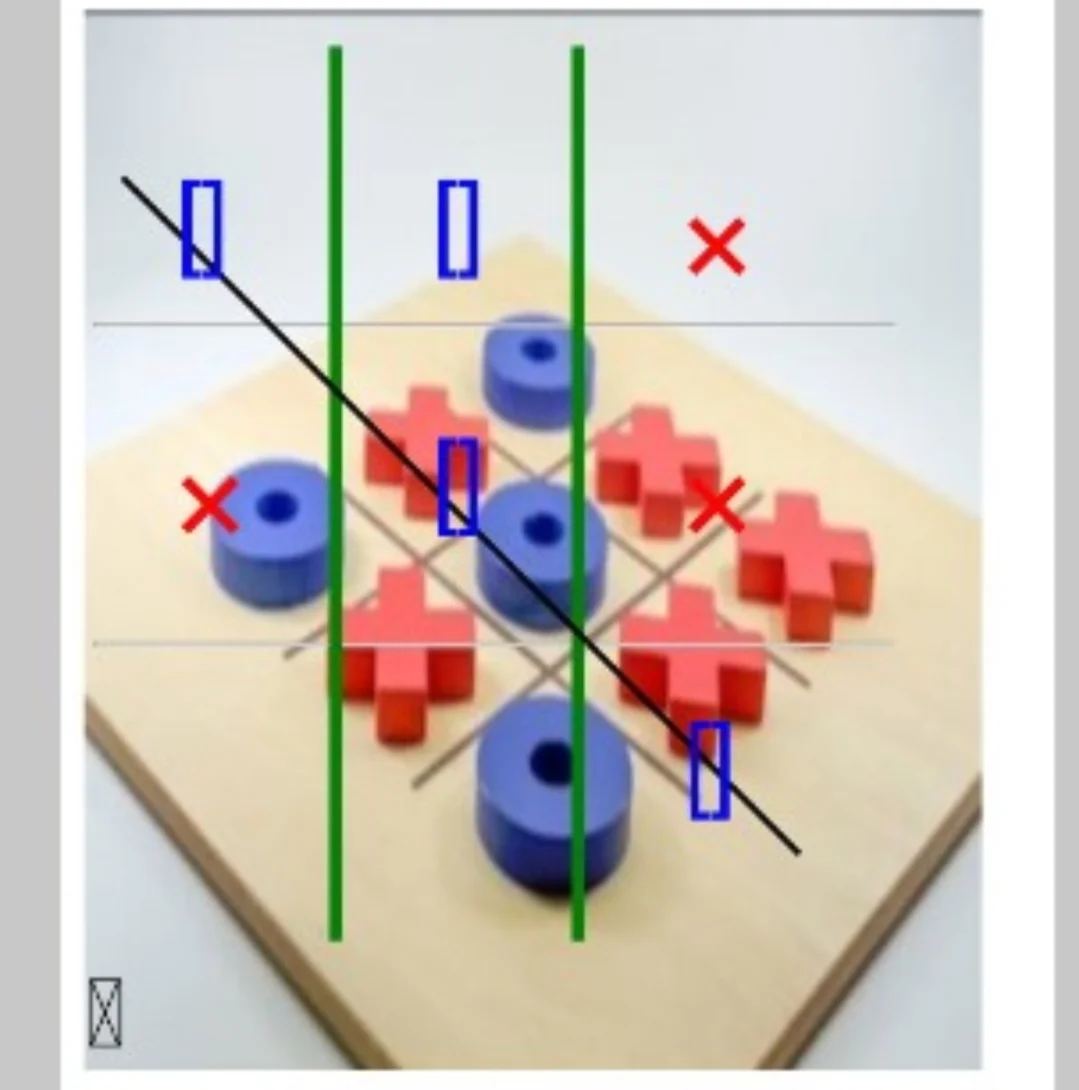
Blocking an opponent's fork: If there is only one possible fork for the opponent, the player should block it. Otherwise, the player should block all forks in any way that simultaneously allows them to make two in a row. Otherwise, the player should make a two in a row to force the opponent into defending, as long as it does not result in them producing a fork. For example, if "X" has two opposite corners and "O" has the center, "O" must not play a corner move to win. (Playing a corner move in this scenario produces a fork for "X" to win.)
Center: A player marks the center. (If it is the first move of the game, playing a corner move gives the second player more opportunities to make a mistake and may therefore be the better choice; however, it makes no difference between perfect players.)
Opposite corner: If the opponent is in the corner, the player plays the opposite corner.
Empty corner: The player plays in a corner square.
Empty side: The player plays in a middle square on any of the four sides.
The first player, who shall be designated "X", has three possible strategically distinct positions to mark during the first turn. Superficially, it might seem that there are nine possible positions, corresponding to the nine squares in the grid. However, by rotating the board, we will find that, in the first turn, every corner mark is strategically equivalent to every other corner mark. The same is true of every edge (side middle) mark.
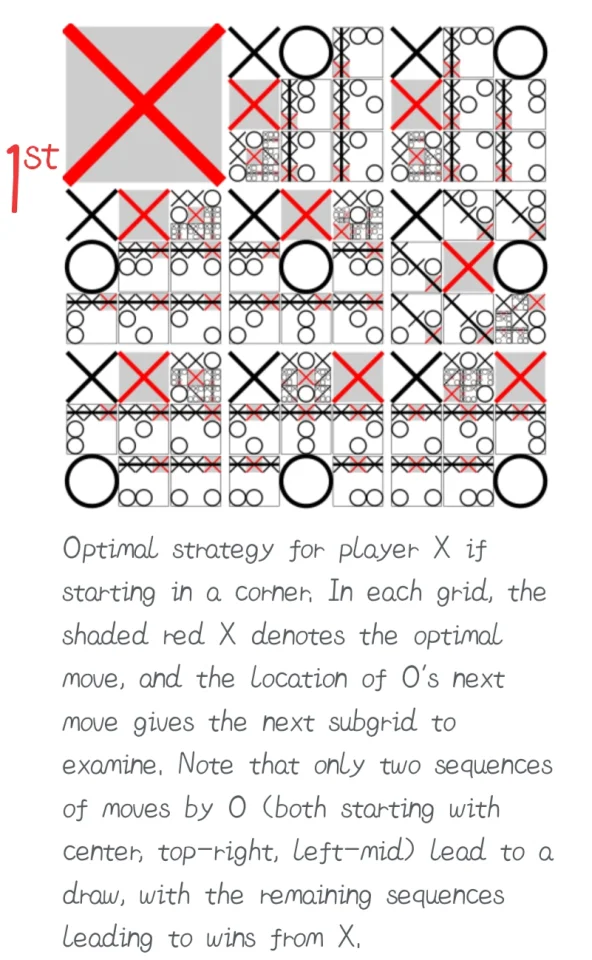
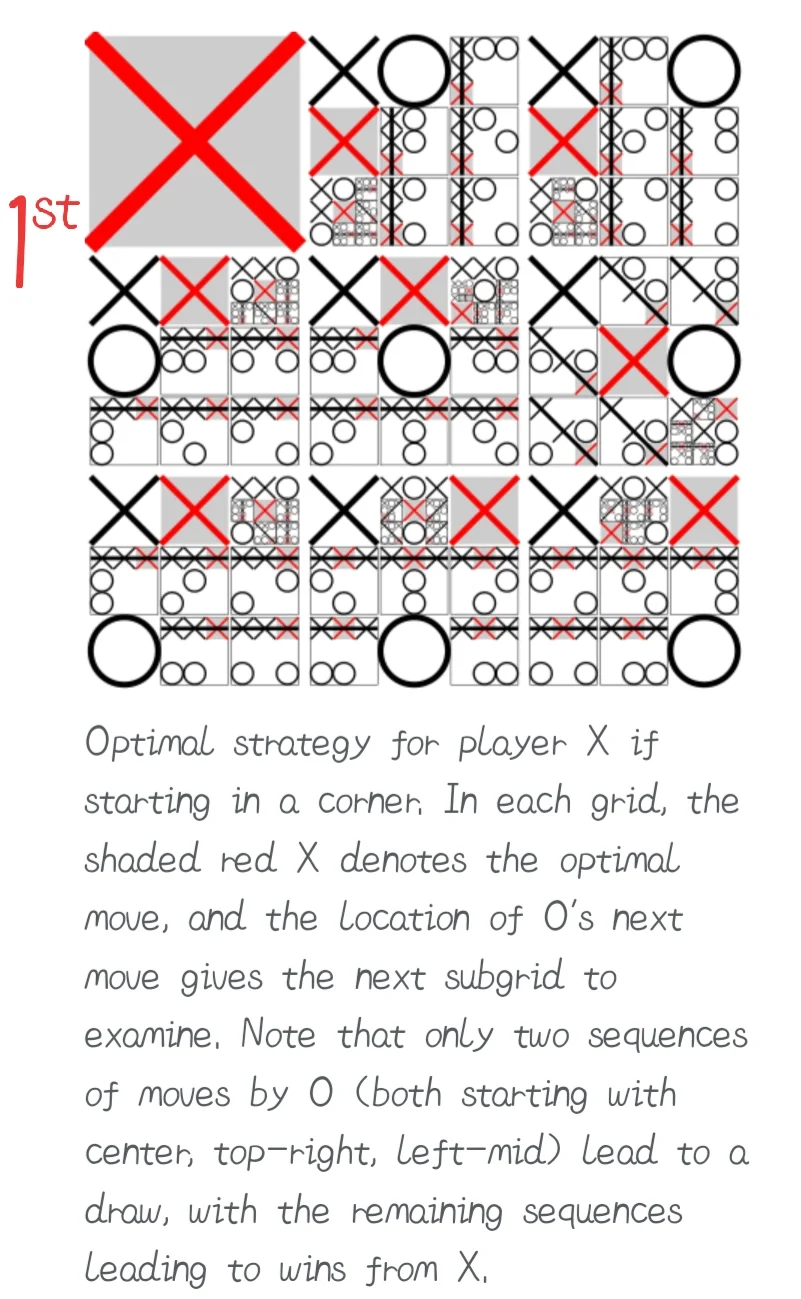
From a strategical point of view, there are therefore only three possible first marks: corner, edge, or center. Player X can win or force a draw from any of these starting marks; however, playing the corner gives the opponent the smallest choice of squares which must be played to avoid losing. This might suggest that the corner is the best opening move for X, however another study shows that if the players are not perfect, an opening move in the center is best for X.
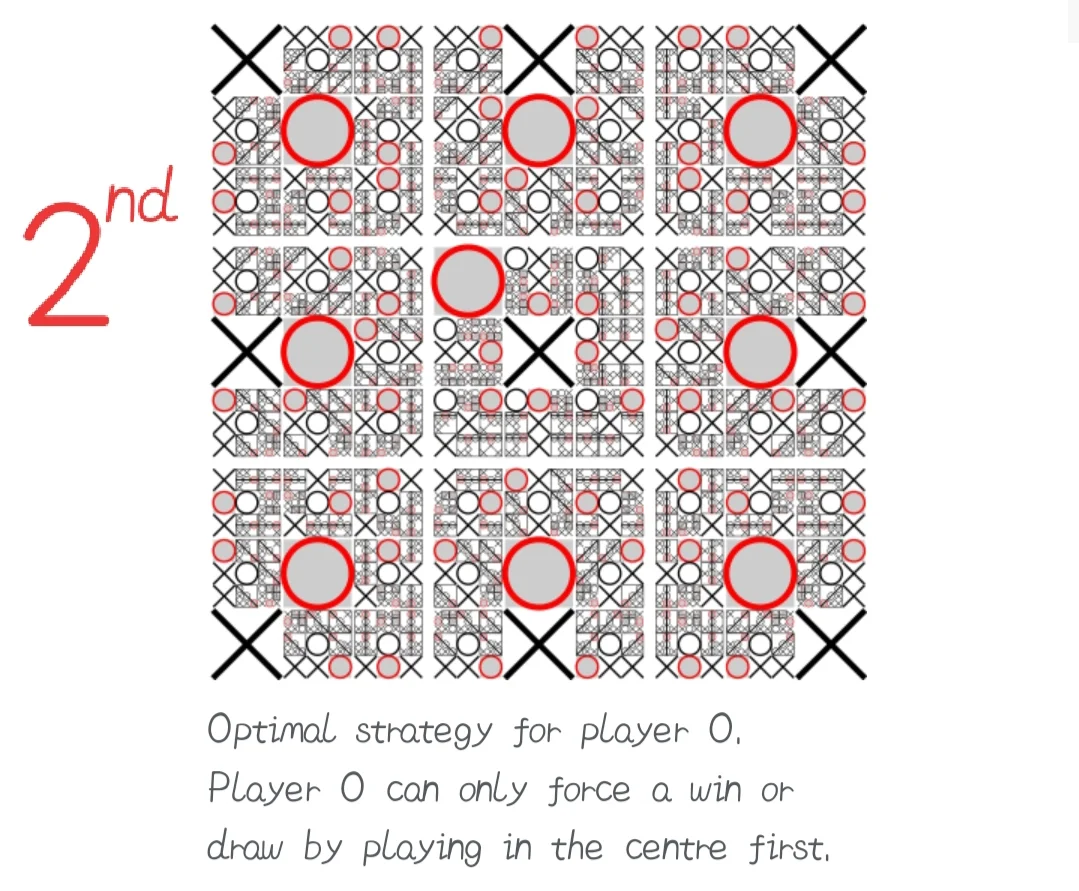
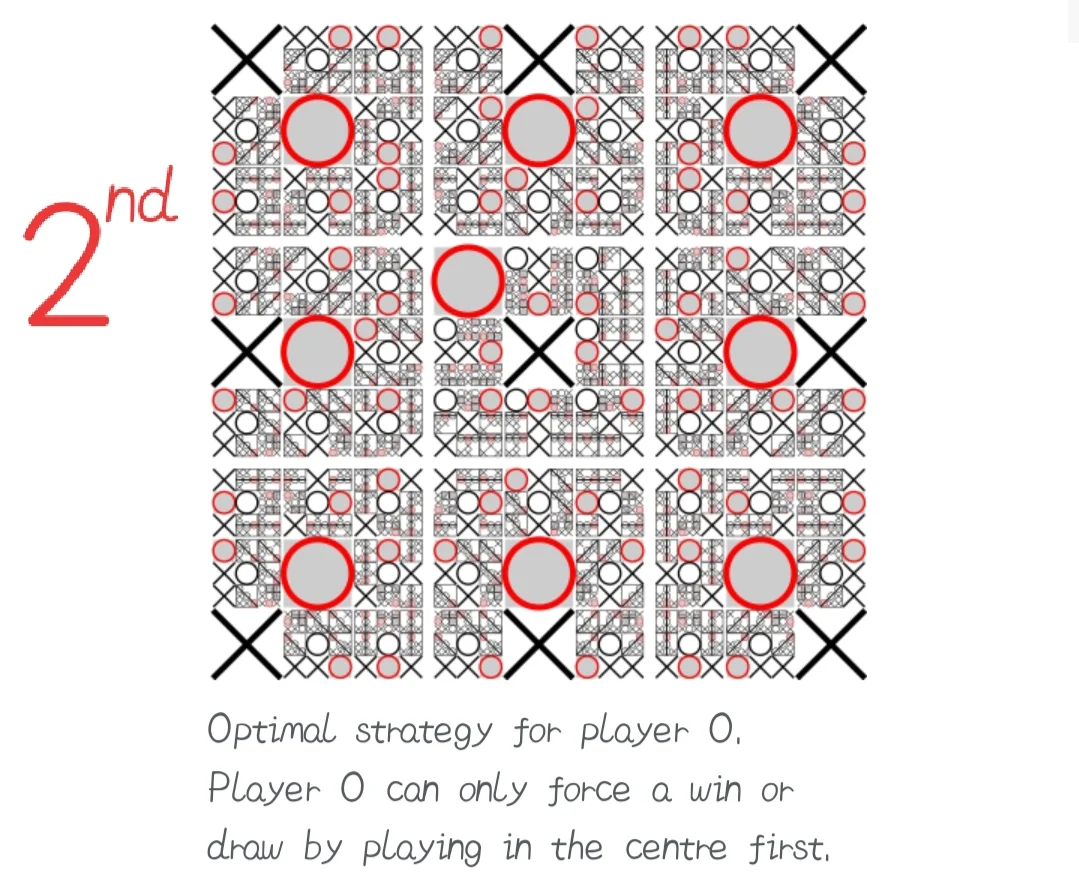
The second player, who shall be designated "O", must respond to X's opening mark in such a way as to avoid the forced win. Player O must always respond to a corner opening with a center mark, and to a center opening with a corner mark. An edge opening must be answered either with a center mark, a corner mark next to the X, or an edge mark opposite the X. Any other responses will allow X to force the win. Once the opening is completed, O's task is to follow the above list of priorities in order to force the draw, or else to gain a win if X makes a weak play.

| Category | Scripts & Code / VB.NET |
| First Release | 15 December 2021 |
| Platforms | iOS 8.0.x, iOS 8.1.x, iOS 9.0.x, iOS 9.1.x, iOS 9.2.x, iOS 9.3, iOS 10, iOS 11, iOS 12, iOS 13, Android 4.1.x, Android 4.2.x, Android 4.3.x, Android 4.4, Android 5.0, Android 6.0, Android 7.0, Android 8.0, Android 9.0, Android 10.0 |
| Files included | .html, .css, Javascript .js |
| Frameworks | VB.NET |